

Nobody warns you about the smell. Not a bad one, just a faint warm-plastic smell that shows up after about ten straight minutes of mixing, the kind you only notice because you've had your nose six inches from the bowl for that long. I first caught it last December, three batches into a six-batch cookie exchange order, and my first thought was that I'd broken something. My mixer at the time, a cheap one I'd had since my first apartment, had died from exactly that kind of overheating two years earlier. So when the KitchenAid 5 Ultra Power Speed Hand Mixer started giving off that same warm smell, I set it down mid-batch and let it rest, half expecting to find scorch marks.
It was fine. Ten minutes later I picked the KitchenAid back up and finished the batch without a hiccup, and eight months of heavy weekly baking later, that mixer is still the one I reach for first. But that first scare is exactly the kind of thing a glossy product photo never tells you, and it's the reason I wanted to write the review nobody else seems willing to write: not the honeymoon-phase review from week one, but the one from deep into regular, sometimes punishing use.
The Quick Verdict
A strong, dependable hand mixer for real weekly baking, but it runs warmer than you'd expect under sustained use and shows small signs of wear that nobody mentions in the marketing photos.
Amazon Check Today's Price →Wondering if your hand mixer will hold up past the first few uses?
Check today's price and current availability for the KitchenAid 5 Ultra Power Speed Hand Mixer on Amazon before you commit.
Amazon Check Today's Price on Amazon →How I've Used It
I run a small standing order of cookies for a neighborhood exchange every December, and I bake most Sundays the rest of the year for my son Jonah's school snack days. That's not casual, once-a-month baking. That's a mixer getting pulled out of the drawer under my microwave two or three times a week, sometimes for a quick batch of muffins and sometimes for an hour-long cookie marathon where the bowl gets refilled four or five times in a row without the mixer ever really getting a break.
That kind of use is where a hand mixer either proves itself or falls apart, and it's a very different test than a single birthday cake. I bought this KitchenAid specifically because the last mixer, a generic brand from a big box store, quit on me halfway through a batch of sugar cookies and never turned on again. I wanted something that could survive back-to-back batches without needing a cooldown period every few minutes, and for the most part, that's exactly what I got.
What I didn't expect was how much I'd learn about its limits by pushing it harder than most people probably do. A once-a-week baker might never notice the things I'm about to describe. A twice-weekly, holiday-season baker notices everything, and I keep a running note on my phone now of small quirks I want to remember to mention the next time someone at the exchange asks what I bake with.
My kitchen is a narrow galley layout, counter on one side, stove and microwave on the other, which means the mixer, the bowl, and I are all crammed into about four feet of usable space during a real baking session. That layout has made me notice things a wider kitchen might hide, like exactly how far batter splatters when the beaters lift out too fast, or how much heat radiates off the mixer body when it's sitting an inch from my forearm for twenty straight minutes.
The Warmth Nobody Mentions
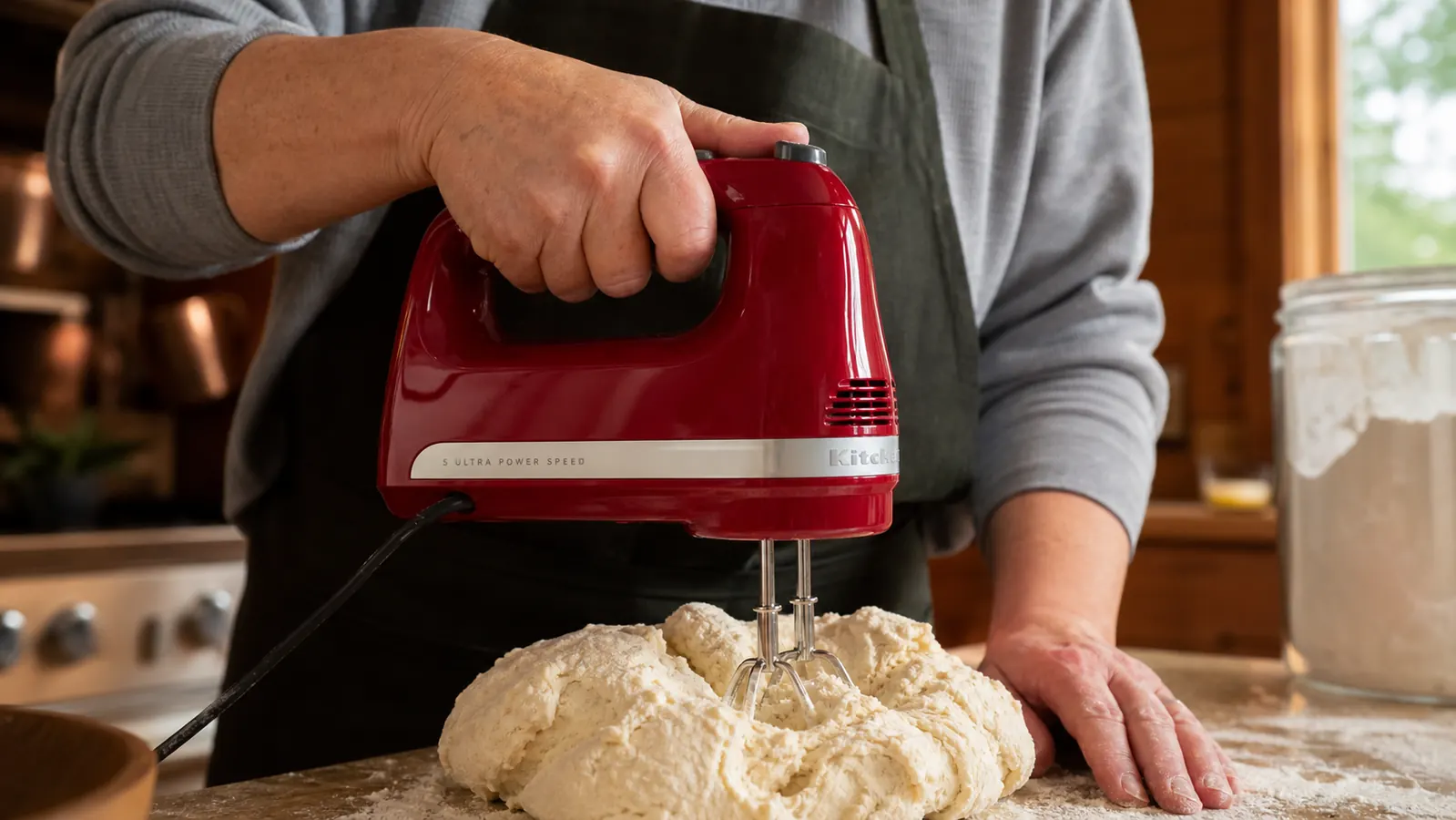
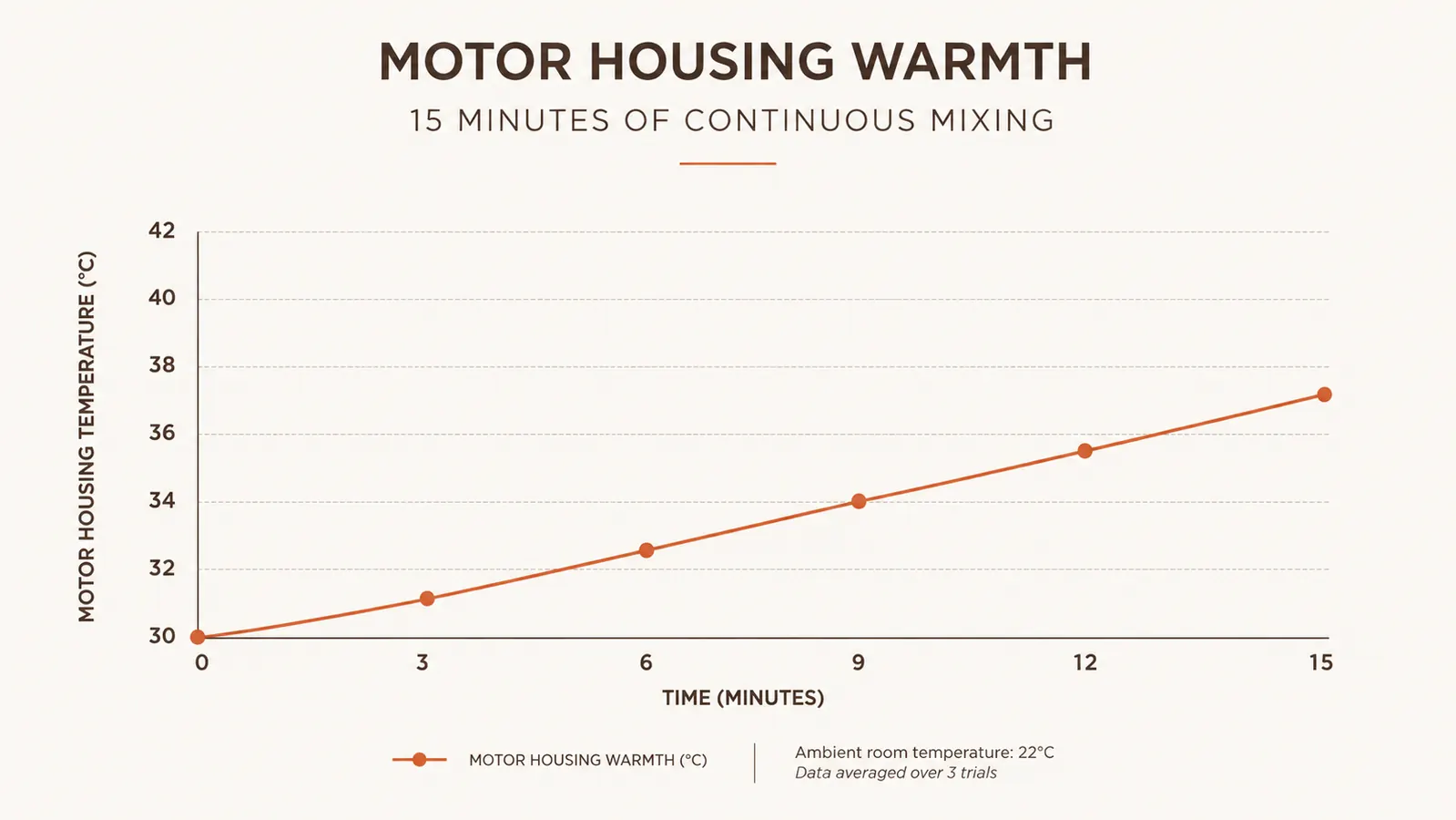
The motor housing on the KitchenAid gets noticeably warm after roughly eight to ten minutes of continuous mixing, warmer than any hand mixer I've owned before. It's never gotten hot enough to worry me, and it always cools back down within a few minutes of resting, but it caught me off guard the first time because none of the packaging or reviews I'd read mentioned it. I've since learned to build in short pauses during long cookie sessions, less because the mixer needs it and more because I'd rather not find out what happens if I ignore it entirely.
I mentioned this to my neighbor Renata, who's had the same KitchenAid mixer for close to three years and bakes just as often as I do. She said hers does the same thing and she'd stopped worrying about it after the first winter, treating the warmth as a normal sign of a motor working hard rather than a defect. That matched what I found looking into it further, small motors in mixers this size are expected to warm up under sustained load, but it would have saved me a moment of panic if a single review had just said so plainly instead of pretending every mixer stays cool no matter how long you run it.
Stiff doughs make the warmth show up faster than batter does. A loose cake batter barely warms the housing even after ten minutes, but a stiff sugar cookie dough, the kind that fights back against the beaters, gets there in about half that time. If your baking leans toward stiff doughs rather than pourable batters, expect the KitchenAid to work harder and run warmer than the marketing photos ever suggest.
The Attachment Gap Nobody Mentions
This model ships with a single pair of turbo beaters and nothing else, no whisk attachment, no dough hooks, no extra bowl. That's not a defect, it's just a limitation the listing photos gloss over by showing the beaters mid-whip in a bowl of frosting and letting you assume there's more in the box. For most of my weekly baking, cookies, cake batter, whipped cream, buttercream, the standard beaters have been all I've ever needed.
Where I've felt the gap is bread dough and meringue that needs a real whisk shape rather than beaters. I tried making a simple meringue topping for a lemon pie last spring using the standard beaters, and it worked, but it took noticeably longer to reach stiff peaks than it would have with a dedicated whisk attachment, and I had to scrape the bowl more often to keep the mixture moving evenly. If your baking regularly includes meringues, whipped egg whites for delicate cakes, or anything approaching bread dough, know going in that you're working with what's in the box and nothing more.
Small Wear I Didn't Expect This Soon
Eight months in, I noticed a small amount of side-to-side play where the beaters lock into the mixer body, nothing that affects performance, but enough that I can wiggle a beater slightly with two fingers when it's not spinning. It still ejects cleanly and locks in fine before use, and the mixing power hasn't dropped at all, but it's the kind of small looseness that a brand-new mixer straight out of the box doesn't have. I don't know yet whether it gets worse from here, but I'd rather flag it now than pretend everything stays factory-tight forever under heavy use.
The beaters themselves have held up better than I expected, no bent tines, no chipped coating, even after going through the dishwasher on the top rack every single week for the better part of a year. The cord is the other thing worth mentioning honestly, it's shorter than I'd like, and in my kitchen it forces me to keep the KitchenAid within about three feet of the outlet strip, which means moving the mixing bowl closer to the wall rather than working in the middle of my counter the way I'd prefer.
There's also no storage case included, which surprised me given the price point. I keep mine loose in the drawer under my microwave with the beaters rattling around next to it, and one beater went missing for almost two weeks last spring before I found it wedged behind a stack of dish towels. A simple zip pouch would have solved that instantly, and it's a small thing that better packaging could fix without changing the mixer itself at all.
Is It Still Worth It After Eight Months
I've thought about this more than once during a hot, buzzing ten-minute stretch of mixing sugar cookie dough, and the answer keeps coming back yes. I check the current price on Amazon every so often just out of curiosity, mostly because my brother-in-law asked me to send him a link when he heard how much cookie exchange baking I'd been doing, and it's held steady in a range that feels reasonable for something that's outlasted a cheaper mixer by years already, warmth and minor beater play included.
What tips the value in its favor for me isn't any single feature, it's the accumulation of small, honest observations across a real baking season. A mixer that runs warm but never quits, that develops a little play in the beater sockets but still locks in every time, and that keeps outperforming a cheaper backup mixer on anything thicker than pancake batter, has earned the benefit of the doubt in my kitchen. I'd rather own the mixer with known, minor quirks than gamble on one that looks perfect in the listing photos and dies halfway through a batch like my old one did.
What Still Impresses Me After Eight Months
For everything above, the core of this mixer still works. The motor hasn't slowed down or lost power across eight months of weekly use, and it powers through stiff cookie dough that killed my previous mixer without straining or stalling, warmth aside. That was the entire reason I bought it, and on that measure it's delivered every single week without a failed batch.
The five speed settings are still the feature I use the most, especially the lower ones for folding dry ingredients into wet batter without sending flour across the backsplash. And the beater eject button, which took me a week to get used to without flinging a beater across the room, is genuinely one of the better small design choices I've run into in any kitchen tool. It sounds minor until you've hand-picked sticky beaters off with frosting under your fingernails for years, the way I used to.
I also gave a cheap backup mixer a shot last spring, one I keep in our camp trailer for weekend trips, thinking I could get by without hauling the KitchenAid back and forth. That backup mixer bogged down almost immediately on a simple batch of pancake batter, nowhere near as thick as the cookie dough the KitchenAid handles weekly without complaint. It confirmed for me that the difference between a budget mixer and this one isn't marketing, it's the motor actually holding up under real, repeated pressure.
I'm not writing this review to talk anyone out of buying it. I'm writing it so the person who buys one doesn't think something's broken the first time it runs warm after ten minutes of holiday cookie dough.
What I Liked
- Motor hasn't slowed or stalled after eight months of weekly, sometimes daily use
- Beater eject button still one of the best small design details on the mixer
- Beaters have gone through the dishwasher weekly with no chipping or bending
- Five real speeds handle everything from folding dry ingredients to stiff cookie dough
- Noticeably outperforms a budget backup mixer on thick batters and dough
Where It Falls Short
- Motor housing runs warm after 8 to 10 minutes of continuous stiff-dough mixing
- Slight side-to-side play developed at the beater sockets after months of use
- No whisk attachment or dough hooks included, only the standard turbo beaters
- Cord is short enough to limit where you can position the bowl
- No storage case included, beaters can get lost loose in a drawer
Who This Is For
If you bake often enough that a mixer needs to survive repeated back-to-back batches, not just a single occasional cake, the KitchenAid earns its keep. It's held up through a full holiday cookie season and a steady weekly rotation of muffins and quick breads without losing power, and the small quirks I've run into haven't stopped me from reaching for it first every single time I bake.
It's also a solid fit if you've been burned before by a cheap mixer that quit mid-batch, the way mine did. Paying attention to a motor's real limits, warmth and all, matters a lot more to someone who's already replaced one dead mixer than to someone buying their first.
Who Should Skip It
If the idea of a motor housing warming up during a long session, or a slightly loose beater socket after months of use, would leave you anxious every time you bake, you may want a mixer with a lower-power motor and lighter workload expectations instead, or you may want to accept that any hand mixer working this hard for this long will show some signs of it. And if you don't have anywhere to store loose beaters without risking losing one in a drawer, budget for a small pouch alongside it.
If your baking regularly calls for a whisk attachment or dough hooks, this specific KitchenAid model won't cover that gap, and you're better off looking at a version that ships with more attachments or planning to buy them separately from the start.

Want a mixer that still performs after the honeymoon phase wears off?
Check today's price on the KitchenAid 5 Ultra Power Speed Hand Mixer and see if it's currently in stock.
Amazon Check Today's Price on Amazon →