
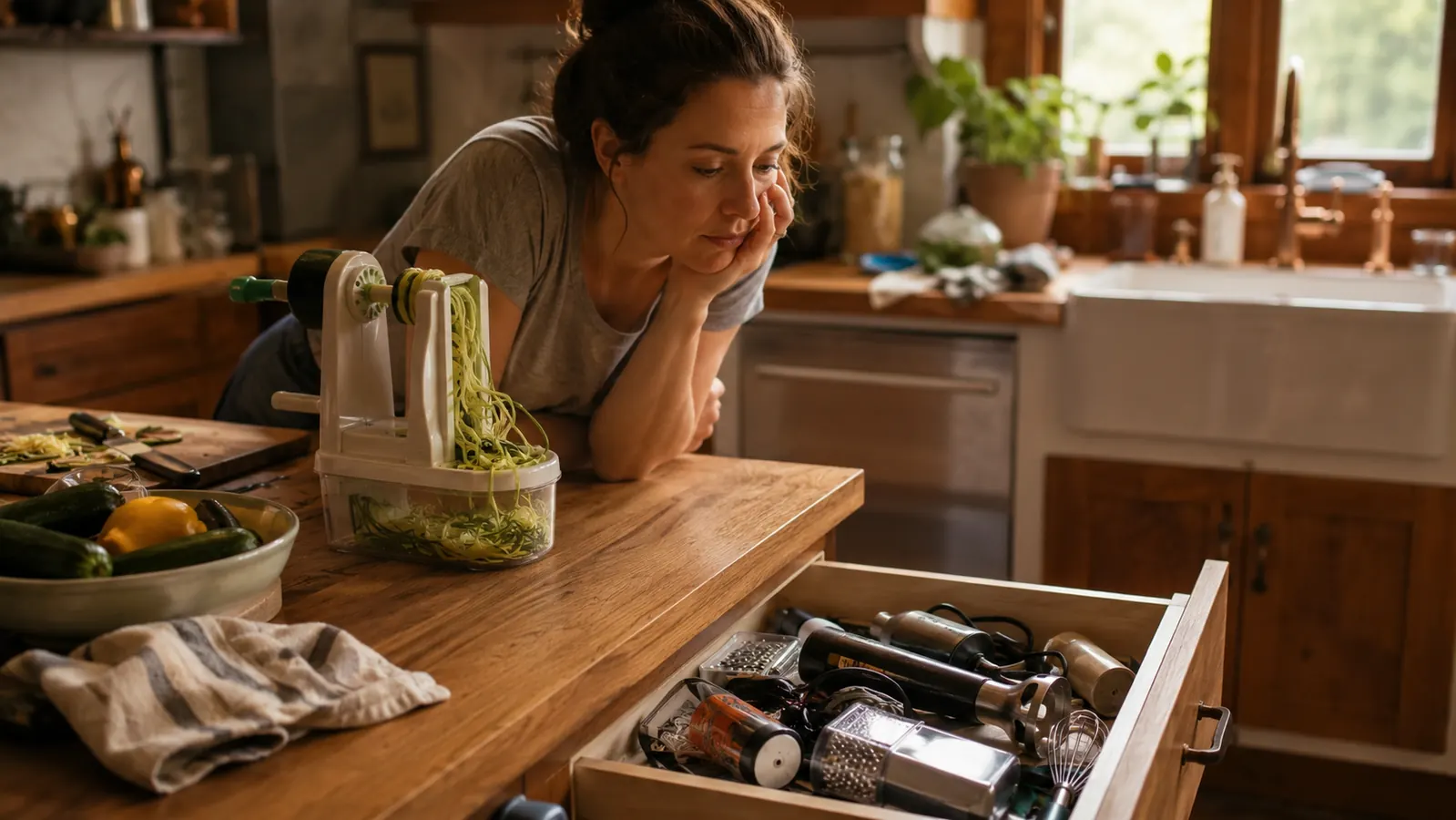
Every kitchen has one drawer where good intentions go to get buried under things you forgot you owned. Mine is the deep one under the stovetop, the one that sticks a little when you pull it open too fast. Before I bought the Brieftons 5-Blade Vegetable Spiralizer, that drawer already held an egg slicer I'd used twice and a garlic press with a broken hinge. I bring up the drawer first because that is exactly where the Brieftons ended up living for a stretch of four months out of the year I've owned it, and that's the part nobody selling you a spiralizer wants to say out loud.
This isn't a six-week review written while the excitement is still fresh. I'm writing this a year after buying mine, after the honeymoon period ended, after a few real snags with cleanup and storage, and after deciding whether the Brieftons earned its spot back on the counter or stayed demoted with the melon baller nobody in my house has ever asked for. Short version: it's back on the counter now. But getting there took some honest trial and error, and that's what this review is actually about.
The Quick Verdict
A genuinely capable spiralizer that makes good noodles fast, but the suction base fights certain counters, the blade storage case cracked within eight months, and cleanup takes longer than any demo video lets on.
Amazon Check Today's Price →Before you buy based on the highlight reel, see the honest version below.
Check today's price and current availability for the Brieftons 5-Blade Vegetable Spiralizer on Amazon, then keep reading for what a full year of ownership actually looks like.
Amazon Check Today's Price on Amazon →How I've Used It
I bought the Brieftons the week before Thanksgiving, mostly because I wanted a lighter side dish that wasn't another casserole on a table that already had three. The first month was strong. I ran it almost every other night, zucchini most often, but also a lot of experimenting since everything felt new and I wanted to justify the purchase to myself. That novelty period is where most spiralizer reviews get written, and it's also the least useful part of the story, because anyone excited about a new gadget uses it constantly for a month regardless of how good it actually is.
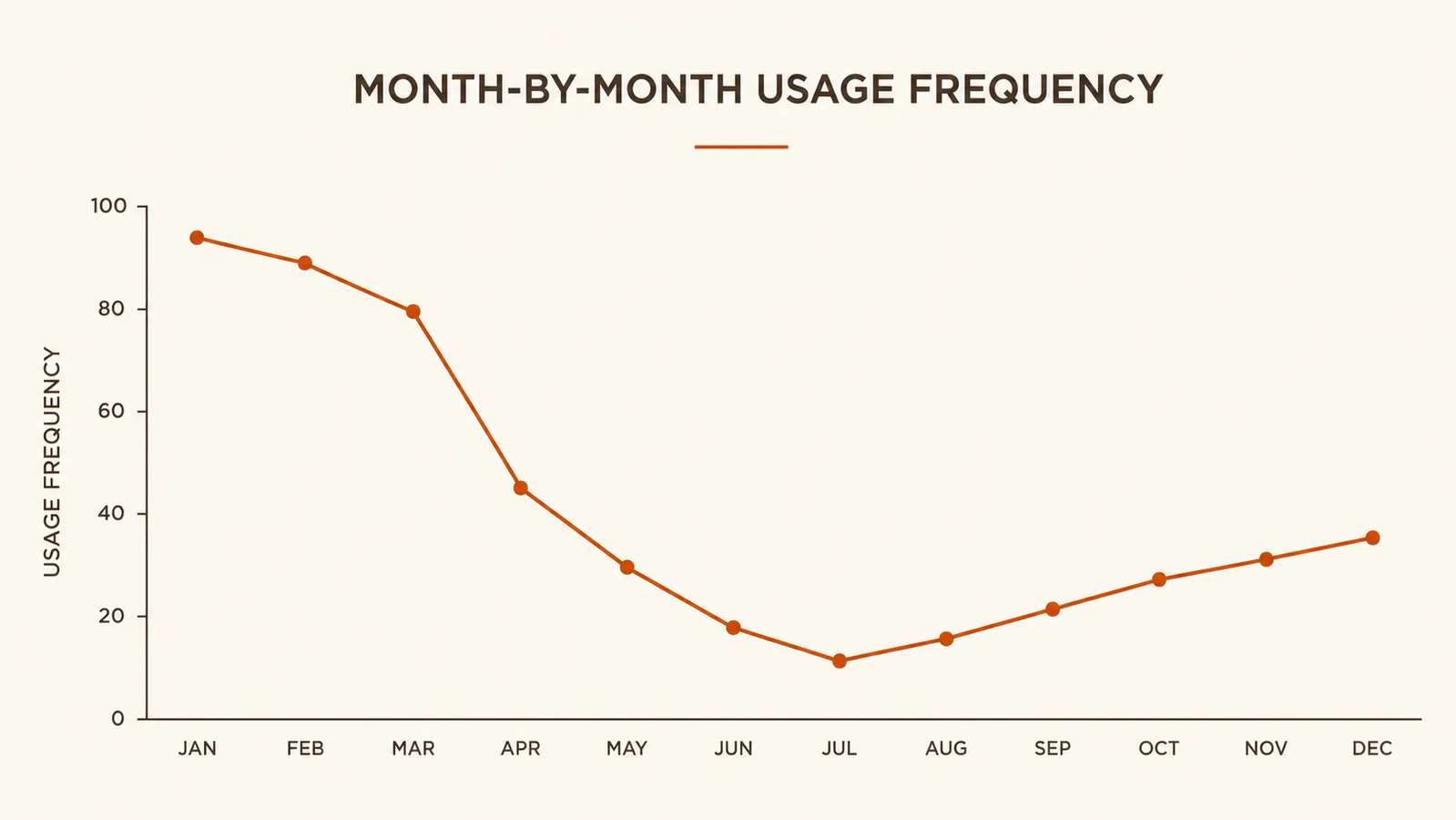
The real test came in month four, right after the holidays, when my counter got crowded with a new slow cooker and a coffee grinder I'd also gotten as a gift. Something had to give, and the Brieftons was the thing that got moved. It sat in the drawer under the stove for roughly four months, from January through April, and I want to be honest that I didn't miss it much during that stretch. I cooked normally, made pasta the regular way, and didn't think about spiralized vegetables at all, which surprised me since I'd expected to feel at least a little guilty.
What brought it back out wasn't a recipe or a New Year's resolution finally kicking in. It was running out of regular pasta on a Tuesday and remembering the drawer held something that could stand in for noodles without a grocery run. I pulled it out, rinsed off a little dust, and ran a zucchini through it in under two minutes. That's when I started paying closer attention to what actually works and what doesn't, instead of just riding the initial excitement like I had the first month.
That second act is really what this review is about. Anyone can write glowingly about a kitchen gadget in its first two weeks, when everything is new and you're still looking for reasons to like it. The more useful question, and the one I didn't have an honest answer to until month twelve, is whether it survives the boredom phase and earns a permanent place once the novelty wears all the way off.
The Suction Base Isn't Universal
Here's something the product photos don't show you. My kitchen island has a faint butcher-block grain to it, not rough exactly, but not perfectly smooth laminate either. The Brieftons' suction feet are built for a flat, sealed surface, and on my island they hold for about ninety seconds of steady cranking before the whole unit starts creeping forward across the counter. On my sister's quartz counter, the same spiralizer locks down and doesn't budge for ten minutes straight, which tells you the difference is the surface, not the unit.
I tried the usual fixes. A damp paper towel under the base helps for a minute or two but dries out fast under friction and needs re-wetting mid-batch. A silicone shelf liner underneath works better and is what I actually use now, but that's a workaround I had to figure out myself over several frustrating attempts, not something mentioned anywhere in the instructions or on the box. If your counters are butcher block, textured tile, or anything less than glass-smooth, budget for a cheap grip mat before you assume the suction base will just work out of the gate.
To be fair, once it's actually gripping, the Brieftons is stable and doesn't wobble mid-crank even with a dense vegetable loaded in. The problem is entirely about getting there on certain surfaces, and it's the single most common frustration I hear from other people who've bought one after I mentioned mine at a dinner. Nobody warns you that the suction cup performance depends almost entirely on a counter you didn't choose with a spiralizer in mind.
Cleanup Takes Longer Than the Demo Video Implies
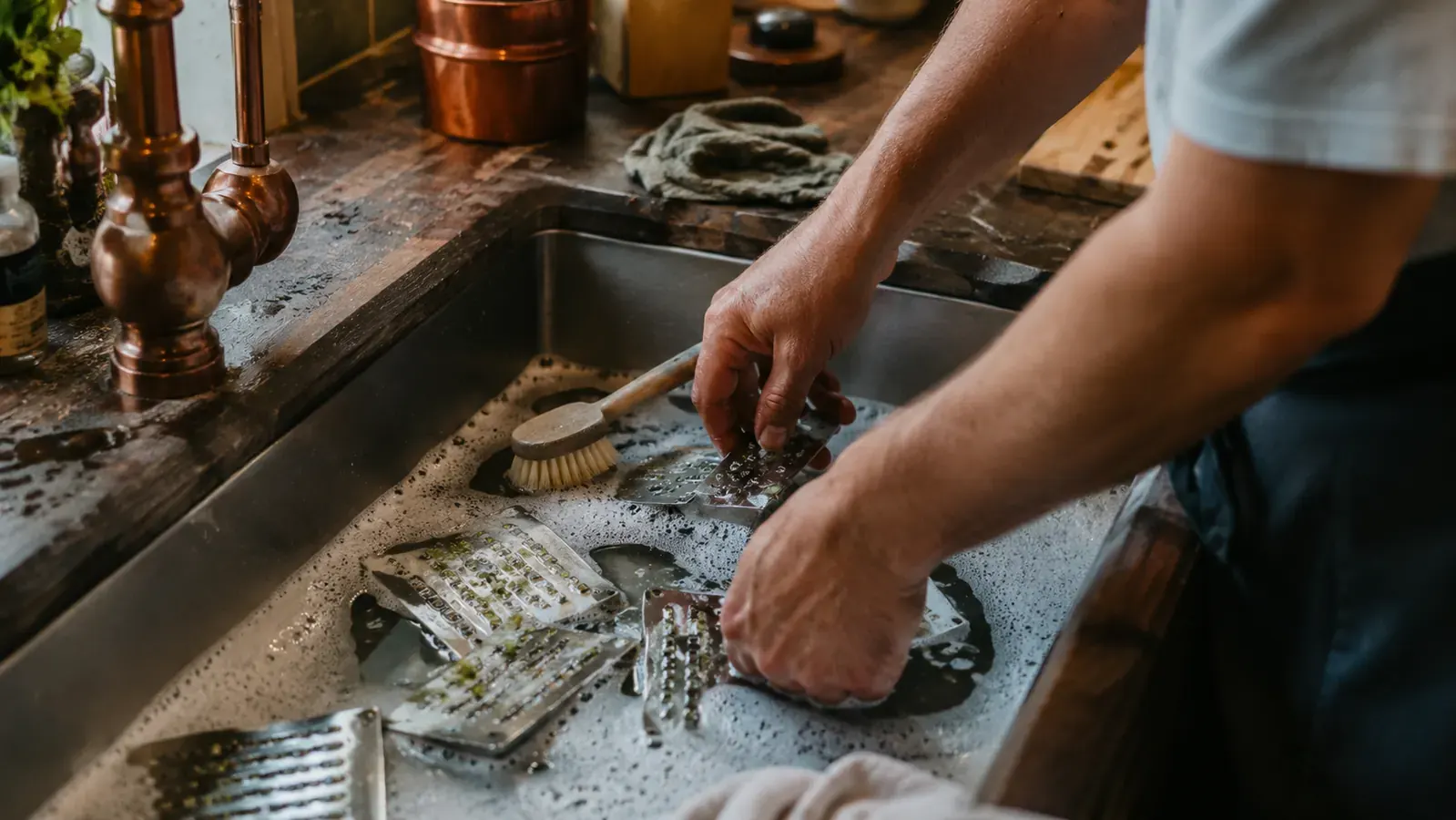
The five interchangeable blades are the whole selling point of the Brieftons, and they do make genuinely different noodle shapes worth the drawer space. What the marketing conveniently skips is that vegetable pulp gets wedged into the teeth of every single blade, and a quick rinse under the faucet doesn't get all of it out no matter how long you run the water. I learned this the hard way after pulling out the ribbon blade a week later and finding dried zucchini bits crusted into the gaps.
My real cleanup routine now takes about eight minutes, not the thirty-second rinse implied by the demo footage on the box. I soak the blades in warm soapy water for a few minutes, then go over each one with an old toothbrush to get the pulp out of the fine teeth on the angel-hair blade especially, since that one clogs the fastest of the five. It's dishwasher safe on paper, and I have run pieces through the top rack, but stuck-on pulp doesn't always come off in a normal cycle, so I still hand-scrub first anyway.
This matters because cleanup time is exactly the kind of detail that decides whether a gadget gets used on an ordinary Tuesday or gets left for the weekend when there's more patience to spare. An extra five to eight minutes doesn't sound like much until it's ten at night and you're the one standing at the sink with a toothbrush going after blade teeth instead of just heading to bed like you'd planned.
The Blade Case Didn't Hold Up
The Brieftons comes with a plastic storage case that holds all five blades in labeled slots, which sounds convenient and mostly was, right up until month eight. The little hinge on the lid cracked after what I'd guess was normal daily-ish use, not any kind of drop or abuse on my part. Now the lid doesn't fully click shut, and I've started keeping the blades in a small zip-top bag inside the case instead so they don't scatter loose in the drawer whenever it gets pulled open.
It's a small thing, and it hasn't affected how the blades themselves cut vegetables. But it's exactly the kind of wear-and-tear detail that a one-month review can't catch, because plastic hinges don't usually fail in week two, they fail after months of ordinary opening and closing. If you're the type who wants everything to stay pristine a year out, know that the case is the weak link here, not the blades or the crank mechanism, both of which have held up fine the whole time.
Not Every Vegetable Is Worth The Effort
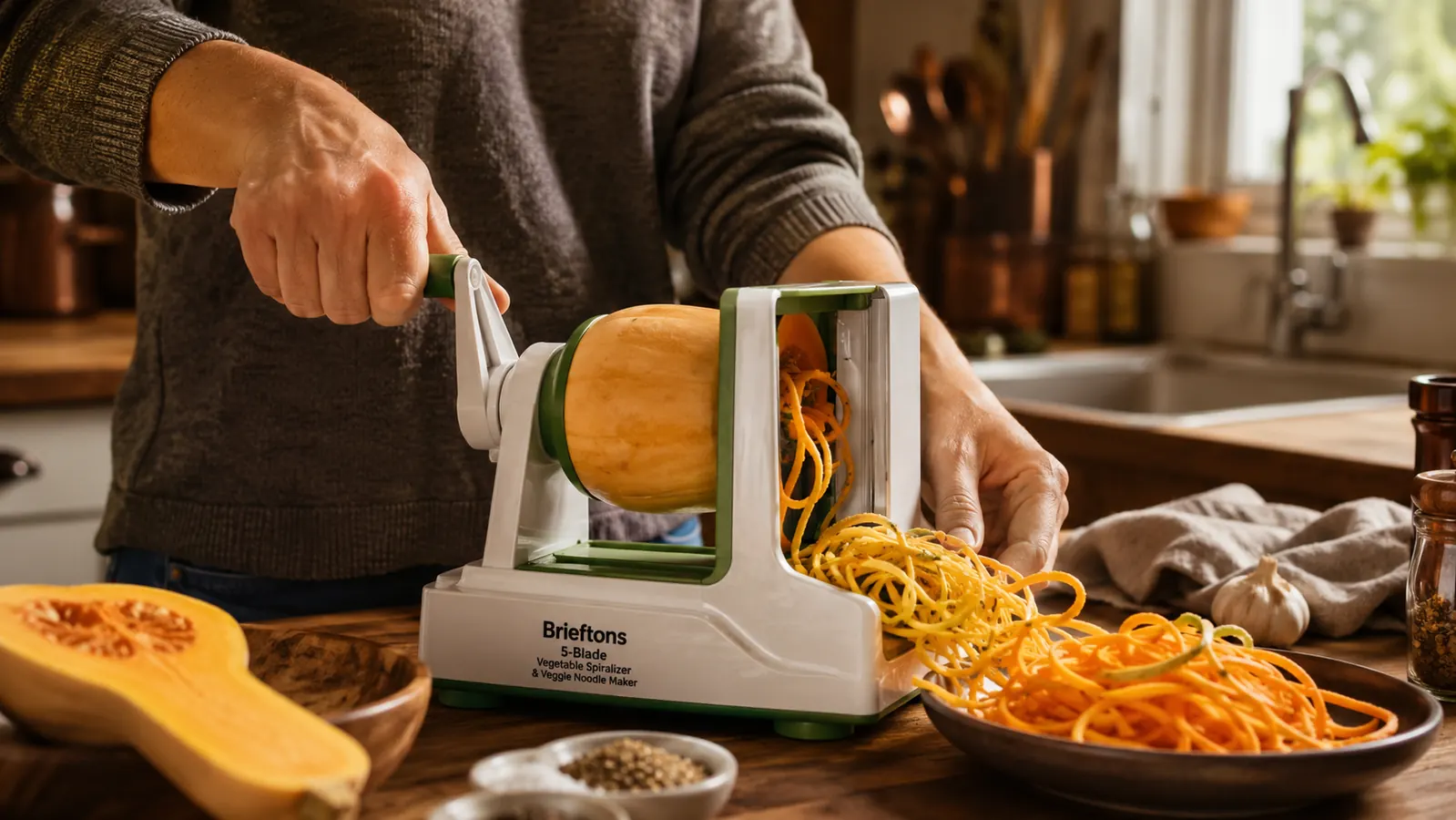
A year of running different produce through the Brieftons taught me that some vegetables are genuinely worth the counter space and some just aren't, no matter what the box photos suggest. Zucchini, cucumber, and sweet potato all spiralize cleanly and hold their shape whether you're eating them raw or cooking them briefly in a pan. Butternut squash works but takes real forearm strength, especially through the neck section before it widens out, and I've had days where my wrist was sore afterward from cranking through a single squash.
Beets were the biggest disappointment of the whole year. They spiralize fine mechanically, but they stained my cutting board pink for two days afterward and left faint color on my fingertips despite wearing gloves the second time. Potatoes were worse, since the starch made them gummy in the blade teeth almost immediately, and I gave up on that combination entirely after the second attempt jammed the crank. Carrots work but tend to snap into short pieces rather than long noodles unless they're perfectly straight to begin with, which most grocery-store carrots simply aren't.
None of this means the Brieftons is a bad spiralizer. It means the marketing photos, which always show a perfect continuous zucchini ribbon spooling out effortlessly, quietly leave out that only a handful of vegetables actually behave that well. If you're buying one expecting every root vegetable in your produce drawer to turn into flawless noodles, that expectation needs adjusting before the box even arrives at your door.
Is It Actually Faster Than Chopping By Hand
This is the question I get asked most when people see the Brieftons on my counter, and the honest answer is: it depends on what you're comparing it to. Against a knife and a julienne peeler, yes, the Brieftons wins easily on a zucchini or cucumber, turning out a full bowl of noodles in under a minute once a blade is locked in. Against just slicing a vegetable into rounds for a stir-fry, though, a knife is faster, because locking a blade in and lining up the vegetable adds thirty seconds a knife doesn't need.
Add the cleanup time back into the math and the speed advantage shrinks further. A knife and cutting board take maybe ninety seconds to rinse and dry. The Brieftons, with its five separate blade inserts and crank housing, takes the eight minutes I mentioned earlier if you're doing it properly instead of a lazy rinse. So the total time, prep plus cleanup, is close between the two methods on nights when I'm only using one blade, and only clearly faster when I need long, uniform noodle strands that a knife genuinely can't produce.
What I Liked
- Makes clean, long noodle strands from zucchini, cucumber, and sweet potato with almost no learning curve
- Five blades cover a real range of cuts, from thin strands to thick ribbons to flat slices
- Crank mechanism and blades have held up fine after a full year of use
- Genuinely faster than a knife when you need long, uniform noodle strands
Where It Falls Short
- Suction base performance depends heavily on your specific counter surface
- Cleanup regularly takes five to eight minutes, longer than any demo video suggests
- Plastic storage case hinge cracked around month eight of normal use
- Dense vegetables like butternut squash take real arm strength to crank through
- Beets and potatoes underperform compared to the vegetables shown in marketing photos
Nobody puts 'the blade case will crack around month eight' in a five-star review, but that's the kind of detail that only shows up after you've actually lived with the thing for a year.
Who This Is For
The Brieftons makes sense for someone who cooks zucchini, cucumber, or sweet potato regularly enough that spiralized versions would actually get eaten, not just made once for a photo and forgotten. It's also a good fit if your counter is a smooth, sealed surface like laminate or quartz, since the suction base problem I ran into mostly disappears on those materials. If you're willing to spend a few extra minutes on cleanup in exchange for genuinely good noodle texture on a regular basis, this earns its keep.
Who Should Skip It
Skip it if your kitchen only has textured or butcher-block counters and you're not willing to add a grip mat underneath, because the wobble will frustrate you within the first week of ownership. Skip it too if beets or potatoes are your main target vegetable, since neither performs close to what the marketing photos promise. And if cleanup time is your biggest cooking bottleneck already, an extra five to eight minutes of blade scrubbing might tip this from a helpful tool into one more thing sitting in the drawer by spring.
Know what you're getting into before it lands on your counter.
See today's price and current availability for the Brieftons 5-Blade Vegetable Spiralizer on Amazon, now that you've got the full year of honest use behind the decision.
Amazon Check Today's Price on Amazon →